How to Read Your Birth Chart for Beginners: Step-by-Step Guide 2026
You’ve probably looked up your Sun sign a hundred times. Maybe you even know your Moon sign and Rising sign. But then someone mentions your “birth chart” and suddenly astrology goes from fun to overwhelming.
You pull up your chart and see a circle filled with lines, symbols, and numbers that look like a math test from an alien civilization. You close the tab. Maybe astrology isn’t for you after all.
I’ve been there. Literally everyone who studies astrology has been there. But here’s the good news — reading your birth chart is actually way simpler than it looks. You just need someone to walk you through it in plain language instead of astrologer jargon.
That’s exactly what we’re doing today. By the end of this article, you’ll be able to look at your birth chart and actually understand what you’re seeing. Not at an expert level — but enough to have genuine “aha” moments about yourself.
Let’s start from zero.
What Is a Birth Chart, Exactly?
Your birth chart (also called a natal chart) is basically a screenshot of the sky at the exact moment you were born. It maps where every planet, the Sun, and the Moon were positioned relative to Earth when you took your first breath.
Think of it like this. Imagine you’re standing outside the moment you’re born, and you look up. The sky is a giant dome above you. The Sun is in one part of the sky. The Moon is in another. Mars is somewhere else. Your birth chart captures all of those positions and draws them on a circular map.
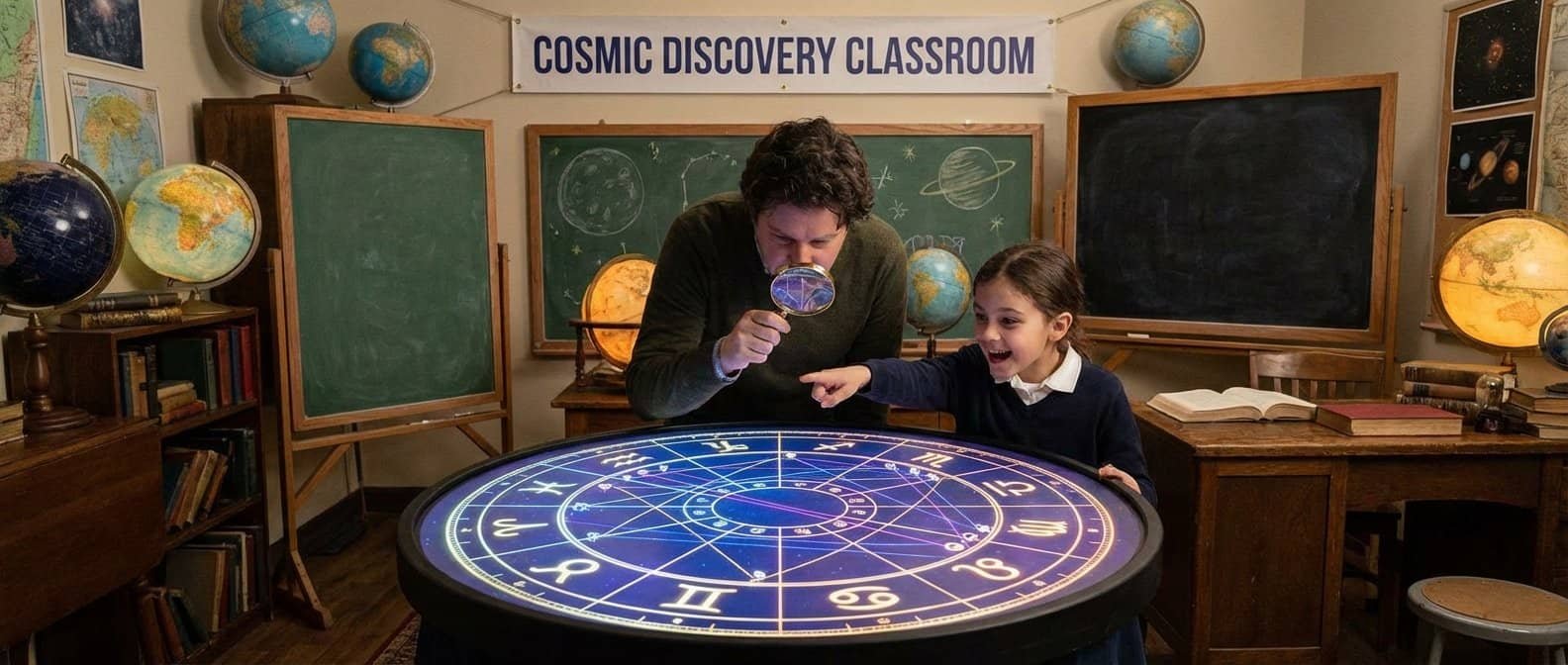
That circular map is what you see when you pull up your chart — a wheel divided into 12 sections, with symbols scattered throughout.
Every position means something. And together, they create a personality blueprint that’s completely unique to you.
What You Need to Generate Your Chart
To get an accurate birth chart, you need three pieces of information. Your birth date — the month, day, and year you were born. Your birth time — as exact as possible, ideally from your birth certificate. And your birth location — the city and country where you were born.
The birth time is crucial. It determines your Rising sign and your house placements, which change approximately every two hours. If you don’t have your exact birth time, check your birth certificate, ask your parents, or contact the hospital where you were born.
If you absolutely cannot find your birth time, you can still get a partial chart. You’ll know your planetary signs but not your houses or Rising sign. It’s like reading a book with a few chapters missing — still valuable, just not complete.
Where to Get Your Free Chart
Several websites generate free birth charts instantly. Astro.com is considered the gold standard among astrologers. CafeAstrology.com offers user-friendly charts with built-in interpretations. Co-Star and The Pattern apps generate charts on your phone with modern interfaces.
I recommend starting with Astro.com for accuracy and CafeAstrology for readability. Generate your chart, save it or screenshot it, and keep it open while you read the rest of this guide.
The Three Big Ones: Sun, Moon, and Rising
Before diving into the full chart, let’s nail down the three most important placements. If you only learn three things from your birth chart, make it these.
Your Sun Sign: Who You Are at Your Core
You probably already know this one. Your Sun sign is determined by your birth date and represents your core identity, ego, and life purpose.
The Sun is who you are when you’re being authentically yourself. It’s your conscious personality — the version of you that shows up when you’re comfortable, confident, and not performing for anyone.
If your Sun is in Leo, your core nature is expressive, creative, and leadership-oriented. If your Sun is in Virgo, your core nature is analytical, service-oriented, and detail-focused.
But here’s what most people miss — your Sun sign is what you’re growing into throughout your life, not necessarily who you are right now. It’s your potential. Some people fully embody their Sun sign by their twenties. Others don’t really “become” their Sun sign until their forties or fifties.
Your Moon Sign: How You Feel
Your Moon sign is arguably more important than your Sun sign for understanding your day-to-day emotional experience. While the Sun represents who you are, the Moon represents how you feel.
Your Moon sign determines how you process emotions, what you need to feel safe, how you nurture yourself and others, and what your instinctive reactions look like when you’re stressed, scared, or overwhelmed.
A person with their Sun in Aries but their Moon in Cancer looks confident and bold on the outside but feels deeply sensitive and emotionally vulnerable on the inside. Their public personality and private emotional reality are very different.
This is why people sometimes don’t relate to their Sun sign — their Moon sign might be running the show emotionally while their Sun sign only appears in specific contexts.
Your Rising Sign (Ascendant): Your First Impression
Your Rising sign is the zodiac sign that was rising on the eastern horizon at the exact moment of your birth. It changes every two hours, which is why birth time is so important.
Your Rising sign determines how other people see you before they really know you. It’s your social mask, your first impression, your automatic public persona.
Someone with a Scorpio Rising appears intense, mysterious, and powerful to strangers — even if their Sun and Moon signs are bubbly and lighthearted. The Rising sign is the filter through which the world sees your entire chart.
Here’s a practical way to understand the difference. Your Sun sign is who you see when you look in the mirror honestly. Your Moon sign is who you are at 2 AM when you can’t sleep and you’re thinking about life. Your Rising sign is who strangers think you are when they first meet you at a party.
Understanding the 12 Houses: Areas of Your Life
Now we’re getting into the part that confuses most beginners — the houses. But I promise it’s simpler than it looks.
Your birth chart wheel is divided into 12 sections, like slices of a pie. Each slice is a “house,” and each house represents a different area of your life.
The Houses Explained Simply
First House — The Self. Your appearance, personality, first impressions, and physical body. This is where your Rising sign lives.
Second House — Money and Values. Your finances, possessions, self-worth, and what you value most in life.
Third House — Communication. How you think, speak, write, and learn. Also covers siblings, neighbors, and short trips.
Fourth House — Home and Family. Your home life, family roots, emotional foundation, and private self. One of your parents is represented here.
Fifth House — Creativity and Romance. Creative expression, hobbies, romance (dating, not marriage), children, and anything that brings you joy and pleasure.
Sixth House — Health and Daily Routine. Your work habits, daily routines, physical health, and how you serve others.
Seventh House — Partnerships. Marriage, committed relationships, business partnerships, and how you relate to others one-on-one. This is the opposite of the First House.
Eighth House — Transformation. Deep psychological change, shared resources, intimacy, death and rebirth cycles, and other people’s money (inheritance, taxes, debt).
Ninth House — Expansion. Higher education, travel, philosophy, religion, publishing, and your search for meaning.
Tenth House — Career and Public Image. Your career, reputation, public achievements, ambition, and your other parent. Also called the Midheaven.
Eleventh House — Community. Friendships, social groups, hopes and wishes, humanitarian causes, and your role within the collective.
Twelfth House — The Subconscious. Hidden things, secrets, the subconscious mind, spirituality, isolation, self-undoing, and past life connections (if you believe in those).
How Houses Work With Signs
Each house in your chart is ruled by a zodiac sign. The sign on the house determines how you experience that area of life.
For example, if Capricorn rules your Tenth House (career), you approach your career with discipline, ambition, and long-term strategic planning. If Sagittarius rules your Ninth House (expansion), your approach to education and travel is adventurous, philosophical, and freedom-seeking.
The combination of house plus sign creates a specific flavor for each area of your life. That’s why two Leos can be so different — they might share the same Sun sign, but their house placements create completely different life experiences.
The Planets: What’s Driving Your Life
Each planet in your chart represents a different drive, motivation, or energy within you. Where it sits (which house) shows where that energy expresses itself. What sign it’s in shows how that energy expresses itself.
Personal Planets (These Change Quickly — Very Individual)
Sun — Your core identity, ego, and life purpose. Takes one year to travel through all 12 signs.
Moon — Your emotions, instincts, and inner needs. Changes signs every 2.5 days, making it very personal.
Mercury — How you think, communicate, and process information. Determines your learning style and communication patterns.
Venus — How you love, what you find beautiful, and what you value. Determines your romantic style and aesthetic preferences.
Mars — How you take action, assert yourself, and handle conflict. Determines your drive, ambition, and anger style.
Social Planets (These Change Slower — Shared With Your Age Group)
Jupiter — Where you find luck, growth, and expansion. Stays in each sign for about one year.
Saturn — Where you face challenges, discipline, and life lessons. Stays in each sign for about 2.5 years.
Generational Planets (These Change Very Slowly — Shared With Your Generation)
Uranus — Where your generation rebels and innovates. Stays in each sign for about 7 years.
Neptune — Where your generation dreams and creates illusions. Stays in each sign for about 14 years.
Pluto — Where your generation transforms power structures. Stays in each sign for 12-31 years.
Reading Planets in Your Chart
Here’s the formula that makes everything click. Planet plus sign plus house equals meaning.
Mars in Aries in the Tenth House means you take aggressive, competitive action in your career. You’re driven to be first, to lead, and to win professionally.
Venus in Pisces in the Fifth House means you love in a dreamy, romantic, idealistic way, especially in creative pursuits and dating. Your romantic life feels like a movie.
Moon in Capricorn in the Fourth House means your emotional nature is reserved, disciplined, and controlled, especially at home. Your family environment was likely structured and possibly emotionally restrained.
See how each combination creates a specific, nuanced meaning? That’s the magic of birth chart reading. No single placement defines you — but together, they paint a remarkably detailed portrait.
Aspects: How Your Planets Talk to Each Other
This is the advanced section, but I’ll keep it simple. Aspects are the geometric angles between planets in your chart. They show which parts of your personality work together smoothly and which parts create internal tension.
The Five Major Aspects
Conjunction (0 degrees) — Two planets sitting right next to each other. Their energies merge and amplify each other. Can be powerfully positive or overwhelmingly intense depending on the planets involved.
Sextile (60 degrees) — A harmonious, friendly connection. The planets support each other easily. Opportunities flow naturally between the life areas they represent.
Square (90 degrees) — Tension and friction between two planets. They’re working at cross-purposes. Challenging but ultimately growth-producing. Most of your biggest personal developments come from your squares.
Trine (120 degrees) — The most harmonious aspect. Planets in trine support each other effortlessly. Natural talents and easy flow. The danger is taking these gifts for granted because they come so naturally.
Opposition (180 degrees) — Two planets directly across from each other. Creates a push-pull dynamic. You feel torn between two needs. The goal is integration — finding a way to honor both sides.
Reading Aspects Simply
If your Moon squares your Mars, your emotions and your actions frequently conflict. You might feel angry when you’re actually sad, or take impulsive action when you need to sit with your feelings.
If your Venus trines your Jupiter, love and abundance flow easily into your life. Relationships tend to be generous, joyful, and growth-oriented.
Don’t try to memorize all possible aspects right now. Just understand that the lines crossing your chart represent conversations between different parts of your personality. Some conversations are harmonious. Others are arguments. Both are necessary.
Your First Chart Reading: A Step-by-Step Method
Now let’s put it all together. Here’s exactly how to read your birth chart for the first time.
Step 1: Identify your Big Three. Find your Sun sign, Moon sign, and Rising sign. Write them down. Read descriptions of each one individually, then consider how they interact.
Step 2: Check your planetary placements. Go through each personal planet — Mercury, Venus, Mars — and note which sign and house they’re in. These shape your daily personality more than the outer planets.
Step 3: Look at house emphasis. Do you have multiple planets clustered in one or two houses? That area of life gets extra emphasis in your experience. Three planets in your Seventh House? Relationships are a central life theme.
Step 4: Notice the elements. Count how many planets you have in each element. Mostly fire signs? You’re action-oriented and passionate. Mostly earth? Practical and grounded. Mostly air? Intellectual and communicative. Mostly water? Emotional and intuitive.
Step 5: Check for major aspects. Look at any conjunctions, squares, or oppositions involving your Sun, Moon, or Rising sign. These create the most significant personality dynamics.
Step 6: Read the whole picture. Don’t get stuck on any single placement. Your chart is a conversation between all of its parts. The full meaning emerges when you consider everything together.
Common Mistakes Beginners Make
After helping dozens of people read their charts for the first time, I’ve noticed the same mistakes come up repeatedly. Avoiding these will save you confusion and frustration.
Focusing only on Sun sign. Your Sun sign is important, but it’s one piece of a twelve-piece puzzle. If you only read your Sun sign, you’re missing most of the picture.
Panicking about “bad” placements. There are no bad placements. Saturn in your chart isn’t a curse. Pluto aspects aren’t doom. Challenging placements represent growth areas, not death sentences. Every great person in history had “difficult” chart placements.
Ignoring the houses. Signs tell you how energy expresses. Houses tell you where it expresses. Knowing you have Mars in Aries is interesting. Knowing Mars in Aries is in your Second House (money) tells you something actually useful — you pursue income aggressively and competitively.
Comparing charts competitively. Your chart isn’t better or worse than anyone else’s. A chart full of trines isn’t “luckier” than a chart full of squares. Trines give natural talent but can create complacency. Squares create challenge but build incredible strength.
Taking it too literally. Your birth chart shows tendencies and potentials, not fixed destiny. Free will matters. Personal growth matters. You are not a prisoner of your chart — you’re the author using it as a character guide.
FAQs About Reading Birth Charts
Can I read my birth chart without my birth time?
You can get a partial reading without birth time. Your planetary signs will be accurate, but your Rising sign, house placements, and Moon sign might be wrong (since the Moon changes signs every 2.5 days). For the most accurate reading, try to find your birth time from your birth certificate or hospital records.
Which birth chart website is most accurate?
Astro.com is considered the most accurate by professional astrologers. It uses the Swiss Ephemeris, which is the gold standard for astronomical calculations. CafeAstrology.com is great for beginners because it includes automatic interpretations alongside the chart.
How often should I look at my birth chart?
Your birth chart never changes — it’s a permanent snapshot of your birth moment. What changes are the transits — current planetary positions relative to your birth chart. Check transits weekly or monthly to see how current cosmic energy affects your personal chart.
Is my birth chart my destiny?
No. Your birth chart shows your natural tendencies, strengths, challenges, and potential life themes. But you always have free will. Think of your chart as a hand of cards you were dealt — how you play those cards is entirely up to you.
What if I don’t relate to my birth chart?
Give it time. Some placements only activate later in life. Saturn themes often don’t click until your late twenties. Pluto themes might not make sense until your forties. Also, make sure you’re reading the full chart, not just your Sun sign. Often, people who don’t relate to their Sun sign strongly identify with their Moon or Rising sign.
What to Do After Your First Reading
Reading your birth chart once is interesting. Using it as a lifelong tool for self-understanding is transformative. Here’s how to keep going.
Start a journal where you track how different transits affect you personally. When Mars moves through your Seventh House, do relationship dynamics actually shift? When Jupiter crosses your Tenth House, do career opportunities actually appear? Over time, you’ll develop a personalized understanding of how astrology works in your specific life.
Study one planet at a time instead of trying to learn everything simultaneously. Spend a week focused on understanding your Mercury placement. Then a week on Venus. Then Mars. Slow, focused learning beats overwhelmed cramming every time.
Join astrology communities where you can discuss chart placements with others. Hearing how other people experience the same placement in different houses and with different aspects deepens your understanding exponentially.
And most importantly, be patient with yourself. Professional astrologers study for years before they feel truly confident reading charts. You don’t need to master everything today. You just need to start.
Curious how today’s planetary transits affect your personal birth chart? Check our daily horoscope for personalized insights based on current cosmic energy.
Updated: February 11, 2026
Tags: Astrology Basics, Beginners Guide, Birth Chart, Chart Reading, Houses Explained, Natal Chart, Planetary Placements